Cash on hand is more than cash sales
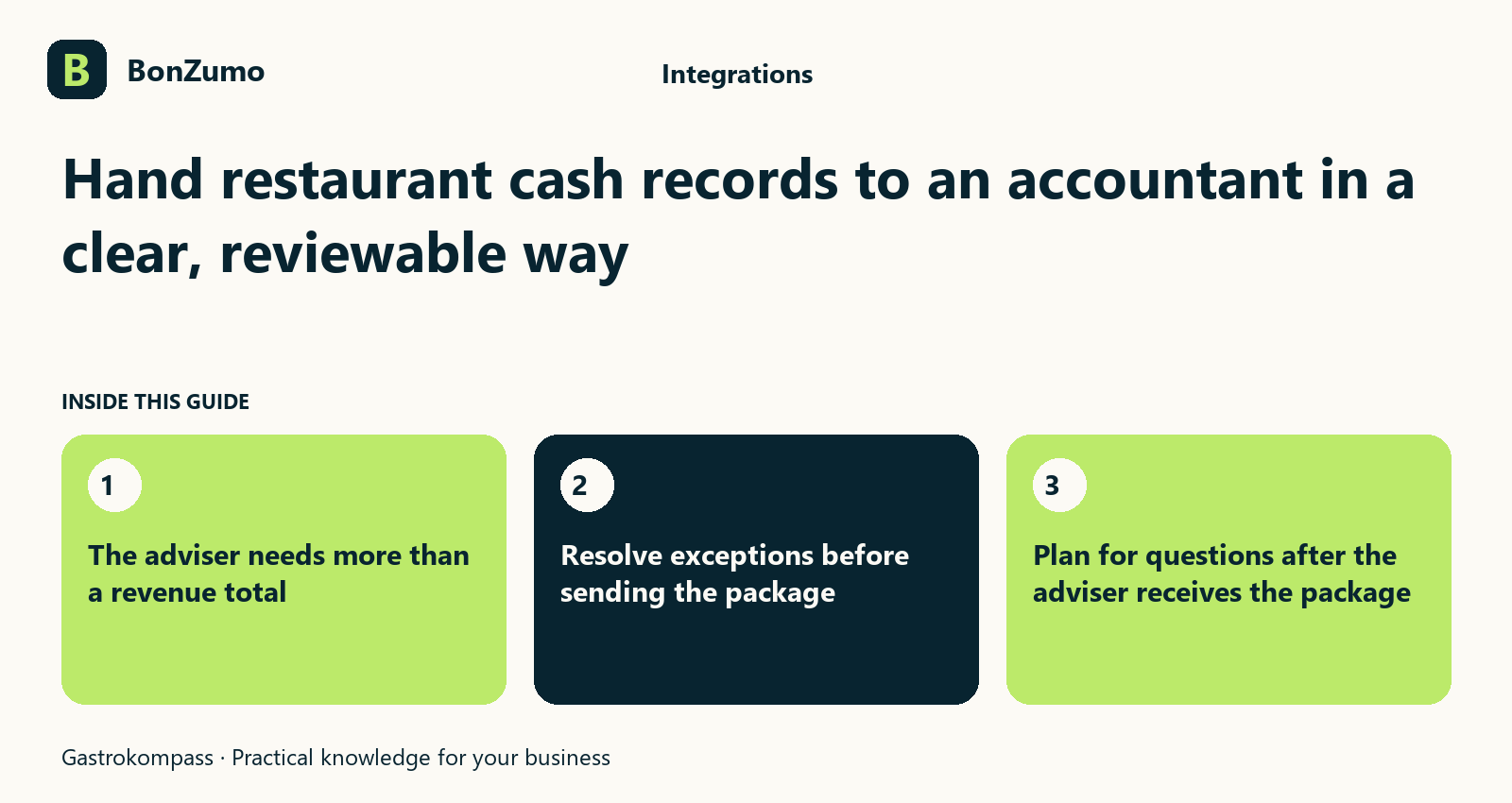
A restaurant till contains more than sales revenue. Change may be added, money removed or tips paid out. Those movements change the counted balance without creating another table sale. A useful cash book therefore separates a sale from a cash movement. Bonzumo has cashbook and closing functions. The detailed recording route should be set up around the workstations and responsibilities in your venue.
Explain additions and withdrawals when they happen
An added float or cash taken for a business expense should not have to be reconstructed from memory at the end of the day. Record who made the movement, when it happened and why. At a shift handover, the next person needs to know the physical amount they are receiving. A cash book helps when its entries match the counted money. It does not decide who may access the drawer or who reviews an unusual movement.
Keep tips distinct from till cash
A guest pays cash and leaves a voluntary extra amount. Your venue decides whether it stays with the server, goes into a team pool or is paid out later. That physical movement should not be silently treated as another sale. A card tip does not put matching banknotes into the drawer at all. Test both cases in a demo and ask how the recorded tip, actual till contents and later close can be understood together.
Connect shift changes to a counted balance
When an early shift hands a register to an evening shift, the sales figure alone is not enough. The person taking over needs a counted amount, known additions and withdrawals, and unresolved questions. Together, they can check whether the recorded state agrees with the physical handover. Several tills or dining areas need clearly assigned responsibility. Bonzumo can bring information together; the handover itself is still an action performed by people.
Describe differences instead of concealing them
A difference might come from miscounted change, an undocumented withdrawal or a confusion between tips and sales. Investigate the cause before someone enters a convenient adjustment simply to make the number look right. Record the time, workstation and amount observed. A traceable exception helps the manager more than a figure made to fit after the event. Check the legal documentation requirements for your business with qualified advice.
Test the cash book with real movements
For implementation, bring a sample sequence: opening float, two cash sales, an addition, a withdrawal, a cash tip and a handover. Work out the expected amount independently and ask to see every step in the planned Bonzumo flow. What can the next shift understand from the record? Only when the story of the cash is clear do reports and exports become a useful basis for accounting and tax-adviser conversations.
A worked example for a till handover
A shift starts with a 120-euro float. Cash sales add 85 euros, and a documented withdrawal removes 30. Without any other movement, the amount to count would be 175 euros. This is a training example, not a rule for every venue. Real shifts can include tips, further floats and several workstations. The important point is not that every employee calculates the balance mentally. Every change needs an identifiable cause, and the physical count must be compared with that recorded sequence.
If the drawer instead contains 170 euros, a manager should not invent a convenient five-euro entry. First check the count, opening float, recorded movements and possible team handovers. Then record the actual difference according to the venue rules. Deliberately recreate this case in a Bonzumo demo. It shows which information the cash book and closing view provide, and where a responsible person still has to make a judgement. Software can support traceability; it cannot replace an honest cash handover.
As a second exercise, make the handover occur while the next shift is already taking orders. Have one person count and another record the result, then introduce a later withdrawal. The next manager should see which number belonged to the handover and which movement followed it. If your venue has two cash drawers, test them separately before looking at a combined report. The exercise makes custody and timing concrete rather than treating the cash book as a form that simply needs to be filled in.