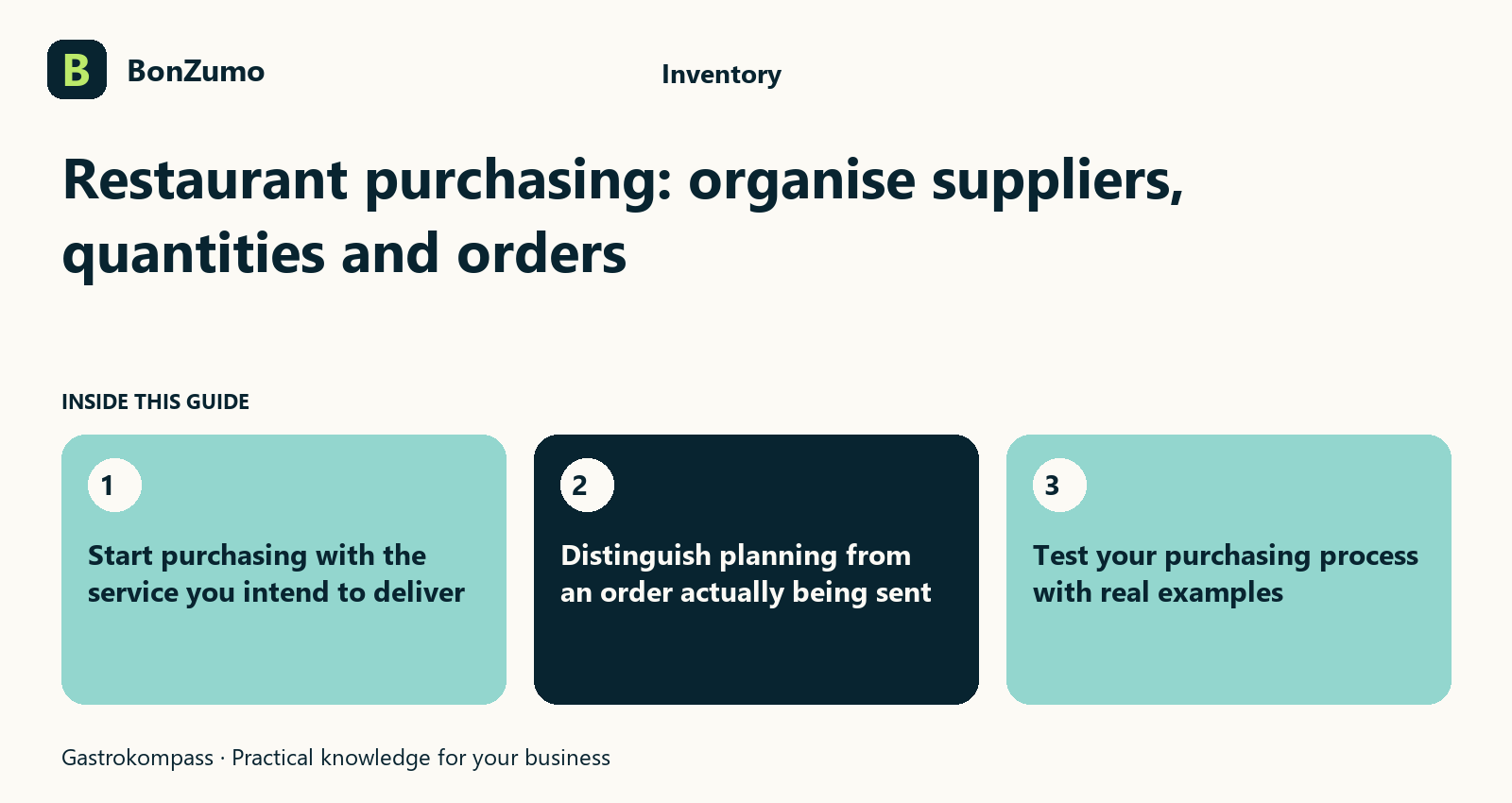
Start purchasing with the service you intend to deliver
When the kitchen is missing an important ingredient, a general shopping list is rarely enough. You need to know precisely which product is required, how much is needed and who can supply it. At the same time, filling storage with goods you cannot use in the coming days creates another problem. Restaurant purchasing works best when the offer, available quantities, delivery conditions and responsibilities are considered together.
Bonzumo includes a purchasing area with order planning and supplier management. Supplier records can hold details such as company name, customer number, contact information and the intended ordering method. A person covering the purchasing role does not have to begin by finding somebody else's address book. The practical benefit is a shared working basis: decisions about demand and quality remain with your restaurant while the information has an understandable place.
Keep supplier information useful for daily work
A supplier name alone is of limited help when an order needs placing. Record the customer number used for your restaurant, the person who answers questions and the agreed ordering channel. Check that the contact information is current and precise. A general company email address may not be the address used for orders. Bonzumo provides fields for these details in supplier management, making them less dependent on one individual's memory.
Consider which information each role needs to see and change. Purchasing contacts, invoice questions and payment details serve different purposes. An effective process gives people what they need without blurring responsibility. Decide who maintains supplier records and how important changes are communicated. If a supplier changes its ordering contact, update the shared information deliberately rather than leaving several private notes with conflicting addresses.
Describe products so the correct goods are ordered
Your kitchen and supplier may use different names for the same ingredient. Check the description, specification, size and packaging. Preparation state may matter for vegetables, bottle size for drinks and the exact cut for meat. An order is clear only when both sides expect the same goods. Those details should also be understandable to someone who temporarily takes over purchasing.
Always give quantities a clear basis. “Three cream” could mean three litres, packs or cases. When a pack changes, consider the effect on planning and recipe costing. Structured product information in Bonzumo provides a starting point for this work. The supplier product relationships used in your configuration should be agreed during setup. A useful quality test is simple: could another person order the same goods using only the information you have provided?
How the ideas connect
The opening sections of this article, shown together.
Start purchasing with the service you intend to deliver
When the kitchen is missing an important ingredient, a general shopping list is rarely enough. You need to know precisely which product…
Keep supplier information useful for daily work
A supplier name alone is of limited help when an order needs placing. Record the customer number used for your restaurant, the person…
Describe products so the correct goods are ordered
Your kitchen and supplier may use different names for the same ingredient. Check the description, specification, size and packaging.…
Compare demand with stock and prepared quantities
Before ordering more, review what is already stored and what the kitchen has prepared. A base recipe in refrigeration may cover part of the requirement while a fresh finishing ingredient is still missing. Work through the planned offer rather than looking only at isolated stock numbers. Which dishes will be sold, which events are expected and which preparation has already been completed?
Use an appropriate time period. A delivery for the next two days should not be confused with a broad weekly allowance. Also consider whether existing goods are suitable for the planned service; a quantity says little about their practical usability. Bonzumo provides product, recipe and stock functions that can inform this discussion. It does not make an unconditional promise of error-free demand forecasting. Planning improves when useful data and the kitchen's judgement work together.
Establish an ordering rhythm and a clear owner
A dependable purchasing process needs an owner and a replacement. Agree when requirements are collected, when they are reviewed and who actually places the order. If several people independently respond to the same shortage, a small gap can become excess stock. A shared plan helps prevent this overlap. Bonzumo's order-planning workflow should be introduced around your real division of work rather than assumed to fit an unspecified purchasing process.
Account for supplier conditions in your routine. A late change may no longer reach the next delivery. Substitution decisions also need an owner: can another brand be used, is a different size acceptable or must the kitchen approve it? Discuss actual examples before a busy service. The purpose is not to add administration but to reduce unresolved decisions when the restaurant is already under pressure.
Distinguish planning from an order actually being sent
A recorded ordering method describes how you communicate with a supplier. It does not by itself prove that an order has been transmitted, received or accepted. Keep these states distinct in your working procedure. If one person prepares a list and another submits it, their handover must be clear. Otherwise a complete-looking plan can be mistaken for a completed purchase.
During a Bonzumo demonstration, follow the intended route from requirement to actual order. Which steps take place in the system, which use the supplier's agreed channel and how is a response handled? This article does not promise a universal supplier connection or automatic confirmation. Your team needs to recognise what has been prepared and what has genuinely been commissioned. That distinction matters both for avoiding missing orders and preventing unnecessary duplicates.
Handle delivery differences deliberately
A delivery may be incomplete, a product may be substituted or the quantity may differ. Compare the goods received with the order and supporting documents. A useful receiving routine considers quantity, product identity and suitability. Decide who can accept a difference, reject it or request clarification. The kitchen should not discover a missing component only when unpacking for the next service.
For example, six packs were ordered but four arrive alongside two replacement packs of a different size. Do not carry forward “six” as if the contents were equivalent. Establish what can actually be used and how the different quantities affect stock and recipes. Bonzumo provides product and supplier information as a foundation; the specific receiving process should be checked within the setup you choose. Assessing the delivered goods remains a real task for the restaurant team.
Compare prices using equivalent quantities
A low price can be assessed sensibly only when quantity and specification are understood. Consider weight, volume, usable yield and packaging. A larger pack may be cheaper per unit but excessive for a small restaurant using a short-lived ingredient. A product that needs substantially more preparation may also change the practical value. Compare what your operation can use, not just the number printed beside a package.
Bonzumo contains purchasing and price functions; the views enabled and used in your restaurant are agreed during setup. Bring two real offers with different pack sizes to a demonstration, then show a recipe that uses the ingredient. This creates a useful conversation between purchasing and costing. Automatic supplier recommendations and guaranteed savings are not assumed. The objective is an understandable basis for your decision.
Make cover and handovers easier
Purchasing should not depend entirely on one person. A replacement needs to know which supplier handles each question, what the quantities mean and which issues remain unresolved. Use maintained supplier information as the starting point, supported by a short internal handover routine. Before holidays, public holidays or major events, review the next planned purchases and the people responsible for them.
After the first weeks, ask where staff still work outside the agreed process. Are product details missing? Does someone still search for an ordering address elsewhere? Is it unclear who approves a replacement? These are specific opportunities to improve the setup. Inventory and purchasing software is useful when it supports the collaboration happening each day. A long feature list alone cannot resolve unclear ownership or incomplete product descriptions.
Questions about suppliers and restaurant purchasing
Can supplier contacts be maintained in Bonzumo? Yes, the supplier area includes company, contact and customer details together with the intended ordering method. Does that mean every order is automatically sent? No. A stored contact is not a universal transmission promise; demonstrate the exact route planned for your installation. Can several suppliers be considered? Supplier records can be maintained and their use in purchasing agreed around your product structure.
Does order planning replace checking stock? It needs reliable information about what is available and required. A targeted count is still useful where quantities are unclear. Does the software select the cheapest supplier? No blanket claim is made here, and price is only part of the decision alongside quality, availability and usable quantity. Where should you start? Often the first useful step is aligning products, units, contacts and responsibility around one clear routine.
Test your purchasing process with real examples
Bring two suppliers, a typical weekly order and a difficult substitution to your demonstration. Include a product offered in several package sizes and a prepared base recipe that changes your requirements. Follow the information needed and the person responsible at each step. Ask explicitly where planning ends and actual ordering begins. This lets you assess whether the proposed workflow fits the way your team operates.
Clear purchasing information helps you prepare the next service. Contacts stay findable, quantities become less ambiguous and follow-up questions are more focused. Bonzumo can provide supplier management and order planning in the context of products and recipes. Arrange a purchasing and inventory demonstration around your actual delivery conditions and kitchen routine, so that the setup addresses a recognisable restaurant task from the start.
Putting it into practice
Later sections put the topic in the context of day-to-day operations.
Make cover and handovers easier
Purchasing should not depend entirely on one person. A replacement needs to know which supplier handles each question, what the…
Questions about suppliers and restaurant purchasing
Can supplier contacts be maintained in Bonzumo? Yes, the supplier area includes company, contact and customer details together with the…
Test your purchasing process with real examples
Bring two suppliers, a typical weekly order and a difficult substitution to your demonstration. Include a product offered in several…