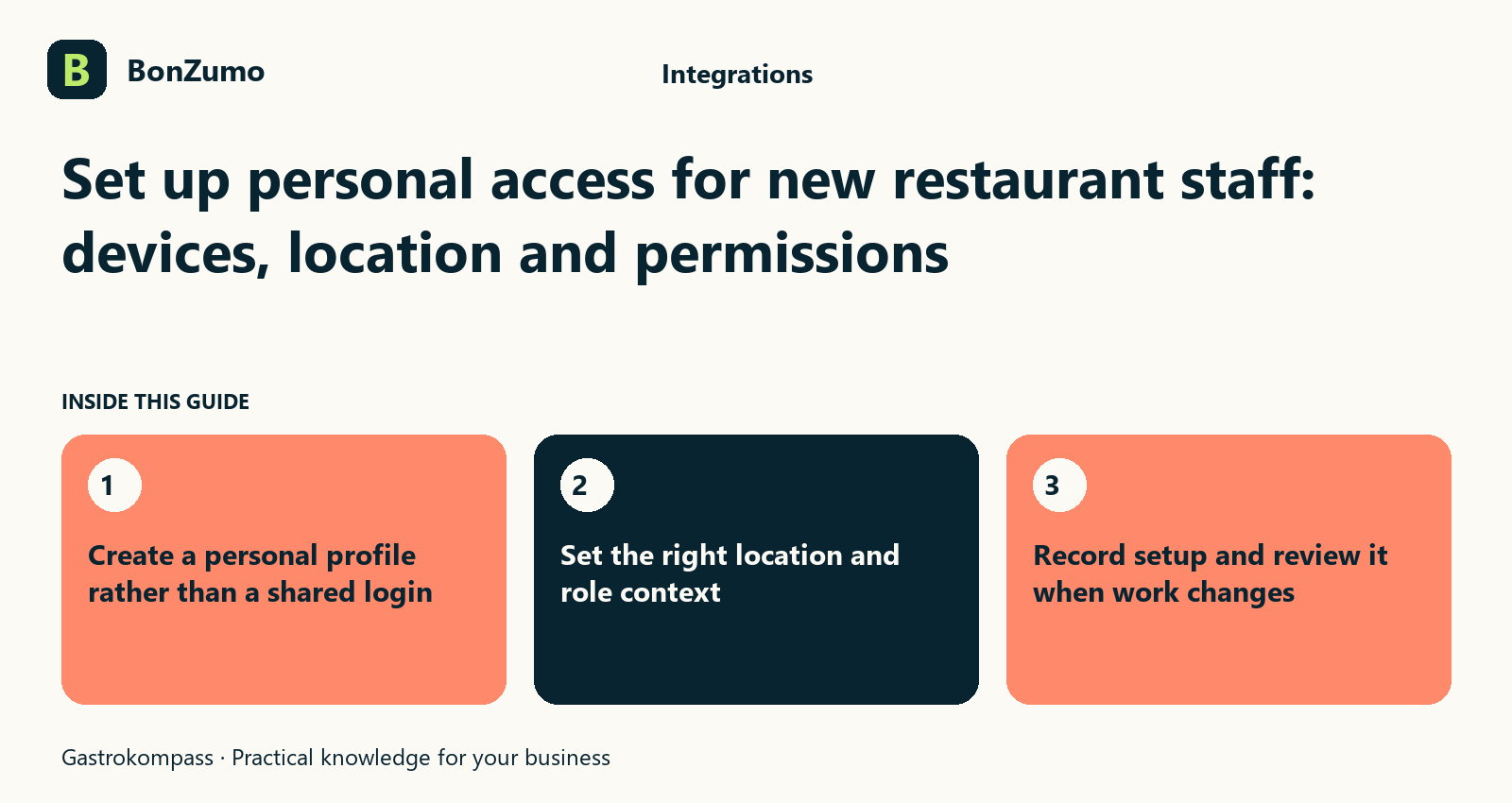
Create a personal profile rather than a shared login
A new service colleague needs access tied to their own identity. A shared till or tablet login may seem convenient on day one, but later questions about orders, approvals and corrections become hard to explain. Create a profile for the person and decide who approves it. Bonzumo provides team identity and roles; technical setup should reflect the planned job rather than copying whichever old profile happens to exist.
Before creation, record only what setup needs: the persons name, venue, intended device and required work areas. Broader training in rota, service and team routines belongs to the separate guide on onboarding new colleagues. This article focuses on whether the person can work under their own access at the intended workstation without borrowing another team members login.
Enable and verify the first sign-in
Creating a profile is not proof of working access. Check how the new colleague receives login details, who supports the first sign-in and where a failed activation is resolved. Credentials should not be left beside a shared device or circulated to a group. The first sign-in must be personally attributed and possible at the intended workstation. If an external identity service is involved, review its own requirements separately.
Before service begins, have the colleague sign in, verify their name and open an area their role allows. Then sign out and check that the next person cannot inherit the session. This tests the technical identity boundary, not every task in service training. If a step fails, the person responsible can resolve it before guests are waiting at the counter.
Test the actual device and work position
A login that works on an office computer may still be awkward on a shared checkout point. Test on the tablet, counter terminal or fixed workstation where the person will work. Are device and work area correct? Can the required screen be reached without another account? What view remains after sign-out? These are access-provisioning questions, separate from whether the colleague has learned the sales process.
If several devices are in use, test at least one of each distinct pattern. A counter device passes between many people; a mobile tablet moves between dining room and terrace. Name who prepares each device and who confirms access after testing. Sound provisioning avoids last-minute broad permissions from a shift lead and makes personal attribution usable during real work.
Set the right location and role context
A multi-area or multi-site venue should not open every area by default for a new account. Decide which site and work context the person needs. Terrace service requires different views from office accounting preparation. Bonzumo can connect team and work areas; exact permitted routes need checking during setup. Assignment to one site does not imply access to staff documents or every venues reports.
Test the role with three technical examples: open an allowed area, perform a normal permitted action and confirm a sensitive area stays unavailable. If a necessary action is missing, adjust the appropriate role instead of handing out a broad admin account. If too much is visible, correct the profile before the first live shift. Access starts proportionate to the job and understandable to management.
Handle third-party accounts separately
A payment service, reservation provider or device may have its own accounts. A Bonzumo profile does not automatically create permissions in every external system. List any additional login used at the workstation and name who administers it. Provider credentials should not become general team knowledge. The new colleague should know which service they may use and who helps if that account is blocked.
Test the connection actually used in daily work. Bonzumo access to a payment transaction, for example, does not prove access at a separate terminal or provider portal. Check both sides independently and record what remains open. This avoids treating a successful sign-in to one system as complete technical readiness for the whole workstation.
Record setup and review it when work changes
Record who created the profile, approved the role and checked the first device sign-in. The note should never contain passwords; it records the verified state and unresolved technical tasks. If the colleague later moves to another area, review device, location and permissions again. A login that worked yesterday is not automatically suitable for new responsibilities.
In a Bonzumo demo, create two sample profiles: one for service and one for office work. Test an allowed action, a denied action and sign-out on each intended device. Staff begin without borrowing credentials, the shift knows who owns account issues and management can explain why access was granted. The separate onboarding guide covers the wider first-day journey through rota and working routines.