“Best” means suitable for this operation
Searches for best restaurant POS system often begin with comparison lists and recommendations. As an operator, I know a system for counter service in a café will not automatically fit a restaurant with reservations, several shifts, and a broad menu. I first describe the work we handle every day: sales, kitchen handovers, guest requests, team organization, stock questions, invoices, and daily close. Only then can I decide which scope we need to assess.
Bonzumo includes known management areas for checkout and sales, orders and kitchen, reservations and guests, team and time recording, inventory, payments and invoices, and reports and daily close. I use these areas as a starting point for a concrete review, not as a ranking or guarantee. Anyone searching for best restaurant POS system should identify which tasks matter in their operation and how the intended configuration supports them.
Compare real situations, not feature lists
For every offer, I prepare the same everyday situations: a standard order, a change after entry, a dish that has sold out, a reservation update, and an invoice question. I ask the provider to show how the proposed setup handles each case, what staff can see, and when a manager takes over. A long feature list does not answer whether a server can recognize the next step.
We rate each case as clear, still open, or outside our needs. Every open item has a written answer and an owner. This lets us compare offers using the same standard and keeps assumptions visible. The query best restaurant POS system becomes a question about which system supports our actual service without unclear handovers.
Prioritize orders, kitchen, and sales
The till is only one part of service. An order change has to be passed on clearly, and an unavailable ingredient needs to be communicated in time. With the team, I check whether Bonzumo’s intended use for checkout and sales as well as orders and kitchen fits our roles. We practise several cases and see whether the next person can understand the status without extra shouting across the room.
I also assess menu maintenance and ownership. Who adds a new offer? Who checks a change? When is the team informed? Even a suitable system needs a routine so kitchen and service use the same item name. I do not include unconfirmed devices or technical connections in the decision. Instead, I ask which capabilities are available in the proposed configuration and which tasks remain ours.
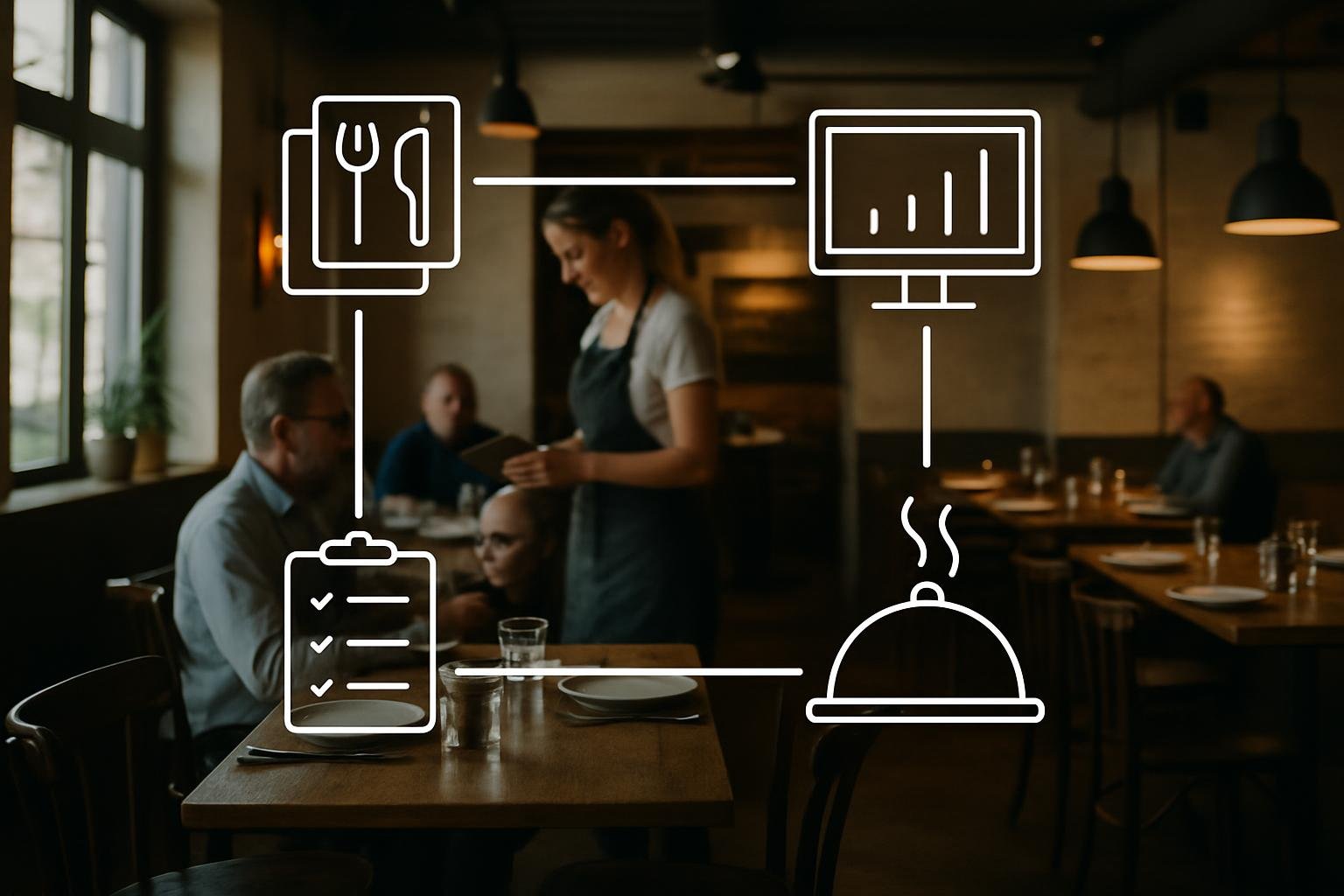
How the ideas connect
The opening sections of this article, shown together.
“Best” means suitable for this operation
Searches for best restaurant POS system often begin with comparison lists and recommendations. As an operator, I know a system for…
Compare real situations, not feature lists
For every offer, I prepare the same everyday situations: a standard order, a change after entry, a dish that has sold out, a…
Prioritize orders, kitchen, and sales
The till is only one part of service. An order change has to be passed on clearly, and an unavailable ingredient needs to be…
Plan guests and reservations realistically
Reservations help us prepare the shift, but they guarantee neither arrival nor an order. I assess how the team handles requests and changes and where information is available to the next shift. Bonzumo includes reservations and guests as a management area. For comparison, I ask what scope is intended and how we should organize ownership and guest information internally.
We limit personal details to what is needed for the agreed operational purpose. If a reservation note is no longer useful, we review whether it should be updated or removed. We refer specialist privacy questions to qualified advice. The best restaurant POS system for our operation does not need to collect everything about guests; it needs to support our planning sensibly and allow responsible maintenance.
Organize payments and invoices clearly
At the end of a visit, a group may request separate invoices or ask about a receipt. We agree who takes the request, who helps with a discrepancy, and how management is informed. Bonzumo includes payments and invoices as an area. I ask the provider about the actual scope and requirements instead of assuming payment methods or invoice features.
We also check how a new colleague learns the internal steps and whom to ask for help. A clear routine helps prevent a guest from being sent back and forth between checkout and service. If tax, record-retention, or TSE questions arise, we obtain qualified advice and technical documentation. I do not infer legal confirmation from a product description.
Include reports, team, and inventory
Reports and daily close can help management review information regularly. Bonzumo includes these areas as well as team and time recording and inventory. We decide who checks which information and how an exception is documented. For stock, we start with information we can realistically maintain rather than assume full automation.
A fair comparison also considers the work after launch: Who maintains the menu, briefs new staff, updates stock, and follows up on open points? The best scope for our restaurant is the one we can use responsibly. In the search for best restaurant POS system, I consider the time and ownership our team can realistically provide alongside ease of use.
Document the decision and review it after launch
Before deciding, I summarize requirements and provider responses. For each area, I record whether it is needed, what has been confirmed in writing, which conditions apply, and what remains open. I compare terms only using current offers for the same scope. I do not invent savings or performance figures to make a choice sound more convincing.
After the first weeks, we review the chosen workflows again: Where did staff need to ask for help? Which reports or stock information were used? Which task had no owner? We then adjust one rule or selection decision deliberately. I assess Bonzumo using what the provider confirms for the specific setup and what our shifts actually need. That gives the search for best restaurant POS system an evidence-based answer from our own operation.
For a fair comparison, I use a decision matrix completed with the people responsible for shifts. For each area, we record need, provider response, prerequisite, internal effort, and open point. An offer does not win simply because it lists more terms. We need to test the same situation with every provider and record who confirmed each answer. This turns best restaurant POS system from a generic ranking into a selection based on our actual requirements.
The review should include the people who carry service. I ask service, kitchen, and management to assess a typical workflow: Is the label understandable? Is the handover clear? Does someone know who decides when a case differs? If only management has seen a demonstration, important experience is missing. We schedule a short practical review with the relevant roles and note any questions that remain. This prevents a decision from resting only on the impression of a presentation.
For cost and contract terms, I request current written conditions for the specific configuration, term, included services, and possible additional work. We do not use historical market prices or assumed savings. We record internal time for item maintenance, briefing, and reporting separately from external amounts. If offers include different areas, we mark the difference instead of presenting them as a direct price comparison. For best restaurant POS system, traceable scope matters as much as the stated terms.
Before making a final choice, the responsible manager gathers open questions and checks whether each answer comes from an appropriate source. We ask the provider about technical matters; we refer questions about tax obligations to qualified advice. Management decides only when it is clear which points are confirmed and which remain unresolved. The matrix helps avoid accidental assumptions without making the comparison unnecessarily complicated.
After launch, I review the decision against actual use rather than assuming the original plan was perfect. We ask whether the team uses the selected areas, whether any routine still depends on verbal memory, and whether maintenance has a clear owner. If an area is not being used, we find out whether the need was overestimated or the training incomplete. If a new need has appeared, we document it and request a current provider response before expanding the scope.
Bonzumo’s known management areas give us a useful starting checklist, but they do not answer every question about our setup. I compare the confirmed use of sales, kitchen, reservations, team, inventory, payments, and reports with the work we actually perform. I do not assume a particular device, integration, or compliance outcome. The best restaurant POS system becomes a defensible decision when the team can explain why the selected scope fits, what was confirmed, and what remains to be reviewed.
I also ask a manager to revisit the selection with the team after several shifts. This shows whether our criteria hold up in actual service or whether we missed something important. The answer may be that a provider point remains unresolved for now. We document it and agree when it will be clarified instead of hiding it in the comparison. the best restaurant POS system decision stays useful when the reasons and remaining questions remain visible.
To avoid comparing unlike offers, we prepare a one-page summary of the same required tasks and send it to each provider. We ask them to describe scope, prerequisites, staff responsibilities, and support in a consistent format. If an answer is vague, we ask a follow-up rather than filling the gap ourselves. We record current commercial terms separately and do not infer that a broader feature list means better fit. This makes best restaurant POS system a practical selection based on comparable, written information.
Putting it into practice
Later sections put the topic in the context of day-to-day operations.
Organize payments and invoices clearly
At the end of a visit, a group may request separate invoices or ask about a receipt. We agree who takes the request, who helps with a…
Include reports, team, and inventory
Reports and daily close can help management review information regularly. Bonzumo includes these areas as well as team and time…
Document the decision and review it after launch
Before deciding, I summarize requirements and provider responses. For each area, I record whether it is needed, what has been confirmed…