Professional service is a reliable overall performance
Professional service includes everything that makes a visit feel dependable, attentive and smooth: a strong welcome, solid product knowledge, accurate order taking, good timing between floor and production, clear communication, correct billing, calm handling of problems and a clean close to the visit. Friendliness alone is not enough. If my team is warm but mixes up orders, leaves waiting times unexplained or becomes uncertain at payment, the guest does not experience professional service, only good intentions. I therefore organize service as a repeatable operating process with clear standards and room for personality.
A typical example in my restaurant would be a Saturday evening when a two-top walks in without a booking, then a group of five arrives wanting a menu, and later two guests at another table ask to pay separately. Professional service does not mean individual employees improvising brilliantly in isolation. It means everyone knows what happens next. Who greets first, who checks suitable tables, when the drinks order is taken, how courses are released, how the bill is split. Guests feel professionalism when they sense security and the team never looks frantic, even under pressure. That reliability is the core of it for me.
The first impression starts before the first drink
Professional service begins on arrival, not at the first order. Guests notice immediately whether they are seen, whether responsibilities are clear and whether the welcome matches the house. That includes eye contact, short orientation, an appropriate table and honest time information. If a table still needs to be reset, I would rather say, “We need three minutes,” than leave people standing without guidance. With reservations, names, party size and area need to be traceable. A clear table plan helps me organize arrivals from the real status of the floor instead of relying on memory. That is exactly why I use a clear table plan, so reception and seating work from the same basis.
Even without a reservation, professionalism stays concrete. A team member should not just ask whether anything is free, but be able to judge which table fits the group size, traffic flow and expected length of stay. A high table by the door may suit two quick drinks, but not a family with a stroller. Decisions like that seem small, yet they shape the service feeling strongly. I therefore discuss with the team not only table numbers, but the purpose of each area: quiet, fast-turning, close to the bar, terrace-friendly or good for larger groups. From the guest perspective, that creates a thoughtful welcome instead of random placement.
Product knowledge and reading needs make advice credible
Professional service does not sell blindly; it advises in a way that fits the table. For that, my team needs to know the menu: ingredients, preparation style, portion logic, menu structure, sensible additions and important notes such as allergens on items. Guests do not want memorized sales language. They want safe guidance. If someone asks whether a dish is lighter or more filling, the answer needs to be honest and specific. The same applies to drinks. An aperitif is not a ritual that must happen; it is an offer that should suit the moment. I therefore expect not aggressive upselling, but attention to what genuinely helps that table: water with wine, a side dish with a main course, dessert suggested only after the main has landed well.
This is where professionalism is often misunderstood. Good service does not push; it structures decisions. If a guest hesitates between two mains, a concrete comparison helps more than general praise: richer or lighter, creamy or fresh, quick from the pass or requiring a little longer. To make that work reliably, I do not leave product knowledge only in people’s heads. Changes, seasonal notes and standards need one shared place the team can consult. That matters especially when new employees join or the menu changes at short notice. Then advice is no longer dependent on whoever has been here longest, but organized as shared quality across the operation.
How the ideas connect
The opening sections of this article, shown together.
Professional service is a reliable overall performance
Professional service includes everything that makes a visit feel dependable, attentive and smooth: a strong welcome, solid product…
The first impression starts before the first drink
Professional service begins on arrival, not at the first order. Guests notice immediately whether they are seen, whether…
Product knowledge and reading needs make advice credible
Professional service does not sell blindly; it advises in a way that fits the table. For that, my team needs to know the menu:…
Clean order taking determines how calm the whole evening feels
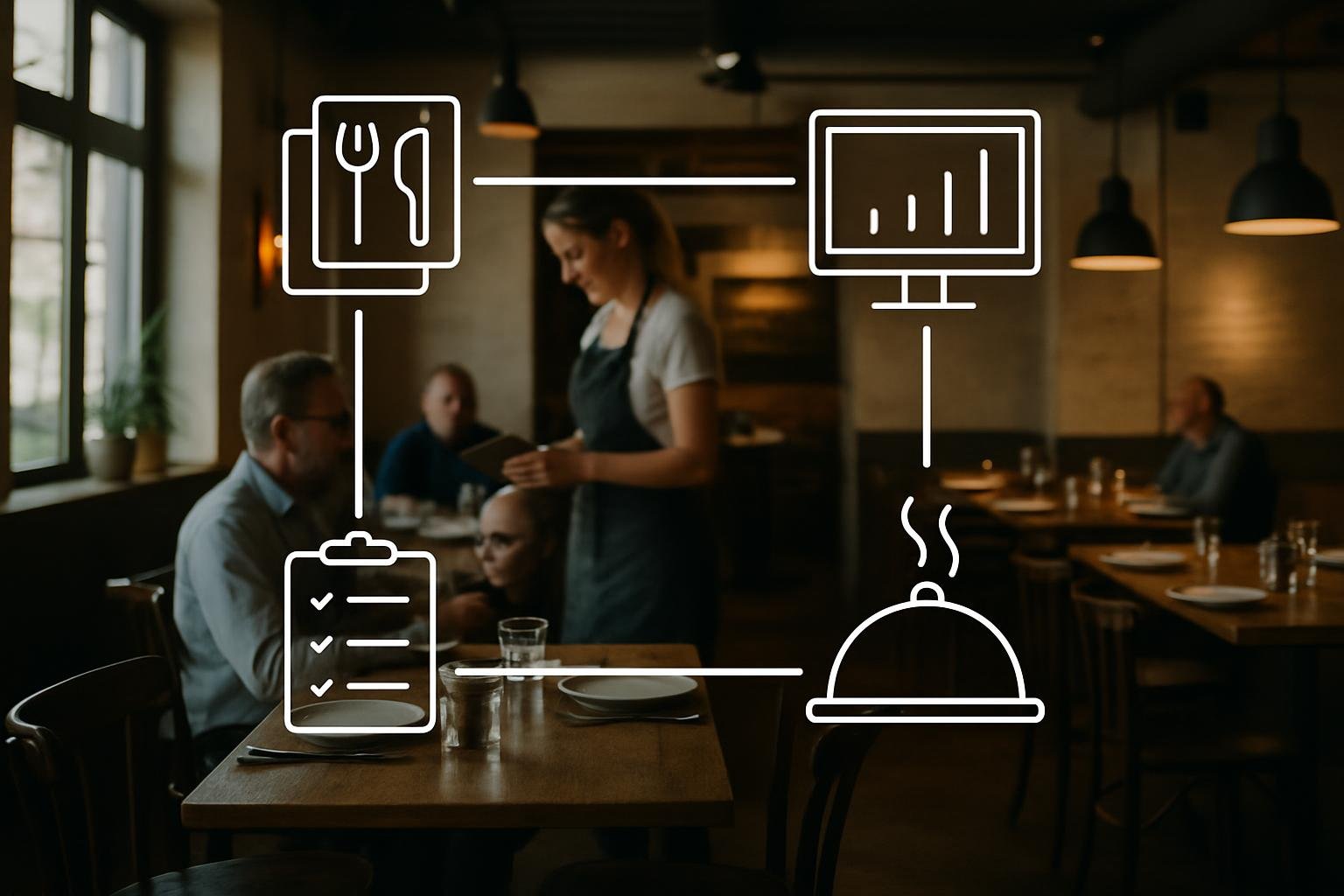
Many service problems do not start at the pass; they start when the order is taken. Service is professional when requests are recorded completely, clearly and on the correct transaction. That includes table reference, items, quantities, modifications and the right moment to send the order on. If someone wants sauce on the side or an ingredient omitted, that cannot live only as a spoken message. I therefore make sure order notes sit directly on the order and that service, kitchen and bar are working from the same transaction. With the connected workflow behind service, it stays understandable what was taken, what is in production, what has been paid and what is still open.
A practical example: table 14 orders two menus, one extra main course and one bottle of wine. It would be unprofessional to fire everything into production at once and later try to slow the table down with shouted corrections. Professional service means clarifying questions before sending, releasing courses at the right time and noting special wishes properly. Then the kitchen knows what is due now, and the floor can control the table’s pace. The benefit is not just fewer mistakes. The whole posture of the room changes. Employees look more secure because they are not constantly correcting, searching or re-explaining. To guests, that feels like attentiveness, even though the real foundation is good organization.
Timing, presence and handovers hold the visit together
Professional service also means being present at the right moment and not interrupting at the wrong one. Guests want to feel noticed, not watched. That requires presence in the room, good walking routes and coordinated handovers. I therefore distinguish between duty moments and observation moments. Duty moments are the welcome, first drinks, the check after mains arrive, the dessert or coffee phase and the payment request. Observation moments are things like nearly empty glasses, searching looks or full plates still sitting after an appropriate time. A team that reacts only when called is not professional; a team that keeps interrupting is not either. Good service presence has a rhythm, and I train that rhythm deliberately with the team.
This becomes difficult when responsibility changes, for example when someone goes on break or another employee temporarily takes over a section. In that moment it becomes visible whether service is individualistic or professionally organized. In my operation, the person stepping in should be able to recognize without a long debrief which tables are waiting, where menus are running, which course comes next and whether payment has already started. Roles and access rights help here because not everyone needs to edit everything, but everyone does need the overview required for their task. Professional service therefore consists not only of behavior at the table, but also of internal handovers that do not feel like a break to the guest.
Service becomes truly professional in difficult moments
You rarely see whether a restaurant works professionally at the easiest table. You see it when something is delayed, mistaken or questioned. Professional service stays calm, takes responsibility and separates explanation from excuse. If a dish is taking longer, I want us to inform the guest before they have to ask. If a side has been forgotten, the answer is not to debate it away but to solve it quickly. My team also needs a clear distinction between what can be resolved immediately, when shift leadership or the kitchen must be involved, and how to speak to the guest without distributing blame across the room. That clarity relieves employees because they do not have to invent responsibility in the middle of an uncomfortable moment.
A useful example is the classic tension between a full terrace and a slowing kitchen. It would be unprofessional to say only, “It’s very busy today.” Professional service gives a concrete and honest orientation: drinks will come right away, starters in a few minutes, mains need longer; then the team follows up in line with that message. Fairness also matters internally. I do not treat mistakes as character flaws. I examine the process. Was the note unclear, the course released too early, the table handover incomplete or the pass priority misunderstood? Only when I review the actual transaction and sequence can I take employees seriously and improve service instead of merely criticizing people.
A professional service always includes a clean finish
The final impression often stays the longest. Professional service therefore always includes a confident close: preparing the bill clearly, handling split-payment wishes correctly, recording tips cleanly, issuing the right receipt and closing the table only when everything is actually settled. Groups reveal very quickly whether a business works in a structured way. Guests paying only for their own items need a different solution from a round that wants the total divided evenly. I deliberately keep this part calm, because visible stress at payment can damage the memory of the whole evening afterwards. Here professionalism means accuracy plus composure, not speed alone.
For my team, I reduce it to a simple but demanding principle: professional service is the reliable connection of attitude, knowledge and process. Attitude without structure overwhelms people. Structure without attitude feels cold. Only both together make a visit coherent. In practice that means clear standards for arrival, advice, order taking, timing, complaint handling and payment; information that can actually be found; roles with fitting permissions; and handovers that do not depend on luck. Then employees can work independently with confidence, and guests feel respected rather than processed. That is what belongs to professional service in a restaurant I take seriously.
Putting it into practice
Later sections put the topic in the context of day-to-day operations.
Timing, presence and handovers hold the visit together
Professional service also means being present at the right moment and not interrupting at the wrong one. Guests want to feel noticed,…
Service becomes truly professional in difficult moments
You rarely see whether a restaurant works professionally at the easiest table. You see it when something is delayed, mistaken or…
A professional service always includes a clean finish
The final impression often stays the longest. Professional service therefore always includes a confident close: preparing the bill…